Monday, 25 June 2007

More preventative measures!


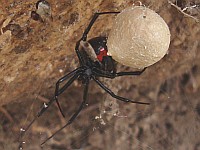
As seen above, the Brown recluse, Loxosceles reclusa, is a venomous, toxic spider that excretes a neurotoxin upon biting. As you can see from the right picture above, the brown recluse has a distinctive morphological characteristic that is known as the "chelo" marking on the dorsal (upper) side of the cephalothorax. This is different from the black widow that contains the "hour glass" feature on the opposite side of the abdomen and not the cephalothorax. These creatures are termed "recluse" for the reclusive nature and ability to hide in small crevices. There has only been one small population of recluses recorded in Florida in a Panhandle county. Most bites that occur elsewhere are generally random isolated cases.
Keep in mind that these tiny, quartered size creatures do not even have the capability of biting someone. If you have ever heared a story about someone being supposedly bitten by a brown recluse, they generally were putting on their shoes, or a bathing suit that had been previously hanging on the clothes line. You get my drift. Brown recluse's have diaxial fangs where widows have axial fangs. This simply means that they cannot bite you and they have to be pressed against you between yourself and something else. Best preventative measure: "If you see one, don't smack it, just flick it off!"

Preventative Measures!


You can now see that distinctive distinguishing feature that black and brown widows have. That "hour glass" marking on the ventral (underside) portion of their abdomens. Another distinctive feature is the egg sac morphology. The Black widow's have a round smooth surfaced eggsac where as the Brown widow's have a bumpy, spiky eggsac. Well, brown widows are becoming more common now versus black widows and are supposedly less toxic and less aggressive; and less of course they are defending their eggsacs. These tiny creatures can become like weeds if you do not destroy their eggsacs immediately upon finding them. Each eggsac can contain up to 500 little baby spiders! Now, if I have ever come upon a mama and her babies, I generally burn them to a crisp with a striker. Works perfect. The babies are too small to bite and the mama generally balls up. Even if the eggsac has hatched, generally the babies will not venture off until they have completed their first molt. Black and Brown widows are ecologically located throughout the state of Florida and tend to nest in dark dry areas. If bitten, they secrete a neurotoxin that ultimately causes a gain-grenous type infection. I suggest to prevent them from establishing, to not let anything just sit there. Like and old tire, or an unused planting pot. Just be careful before turning anything over. Like I said, they are not generally aggressive so just take your time and be careful. Oh yeah, if you get bit, go to the doctor, immediately.

Insects vs. Arachnids?


Do you really know the difference?

This is a common question that kids always want to know the answer to. Honestly, the answer is very easy. There are two main differences. Insects have three body parts: Head, thorax and an abdomen where as Arachnids have two main body parts: Head, and a cephalothorax (combined thorax and abdomen). There is one more very distinctive differential characteristic.

Anybody?

The legs, that's right. Insects have six legs and arachnids have only eight. Well, both insects and arachnids can either be toxic, poisonous or even venomous for snakes of course. Did you know that some insects like blister beetles, aka Bombideer beetles, are able to physiologically sequester toxins from certain plants and use these toxins as defense mechanisms. Pretty cool, huh. Well, tune in to the next post for more insect-arachnid fun facts.

The following pictures are of a:
Chewing Bird Louse, (Menacanthus stramineus) photographed by Adam Holt
Brazilian Pink Salmon Birdeater, (Lasiodora parahybana)

Sunday, 3 June 2007

Getting to know ectoparasites!

Getting to know ectoparasites? The two ectoparasite pictures above are of body lice (Pediculus humanus humanus) and a louse fly respectively. Anyway, I thought you might want to get to know these critters a little better so I have included a link to a powerpoint that discusses vertebrate host parasite immune responses. I think it is pretty cool. Feel free to make comments if you would like.

C:\Documents and Settings\Adam Holt\My Documents\Wondershare PPT2Flash\Vertebrate Host Parasite Immune Response PPP\player.html

Link to picture of body lice
http://creatures.ifas.ufl.edu/urban/human_lice.htm

Link to picture of louse fly:
http://www.britannica.com/eb/article-9049106/louse-fly


Belize, Mexico!


It seems like no matter where you go, insects maintain their abundant nature appearing in various sizes, shapes and colors. Some can be so spectacular and yet some can be so ugly. I found this latern fly, a.k.a. peanuthead, when I was collecting over spring break in Belize. What a beautiful guy!
As a defense mechanism, they have eyespots on their hind wings so when they are in full suit, they ward off predators appearing larger and predator like. This deceiving notion displays an owl mimic appearance representing a raptorial aggressive predator. As an evolved defense mechanism, this has ensured reproductive succession and fecundity.
Below is an amazing video displaying endoparasitic ecological behavior. It is quite grotesque but only reveals the true possibilities of traveling outside the country.